

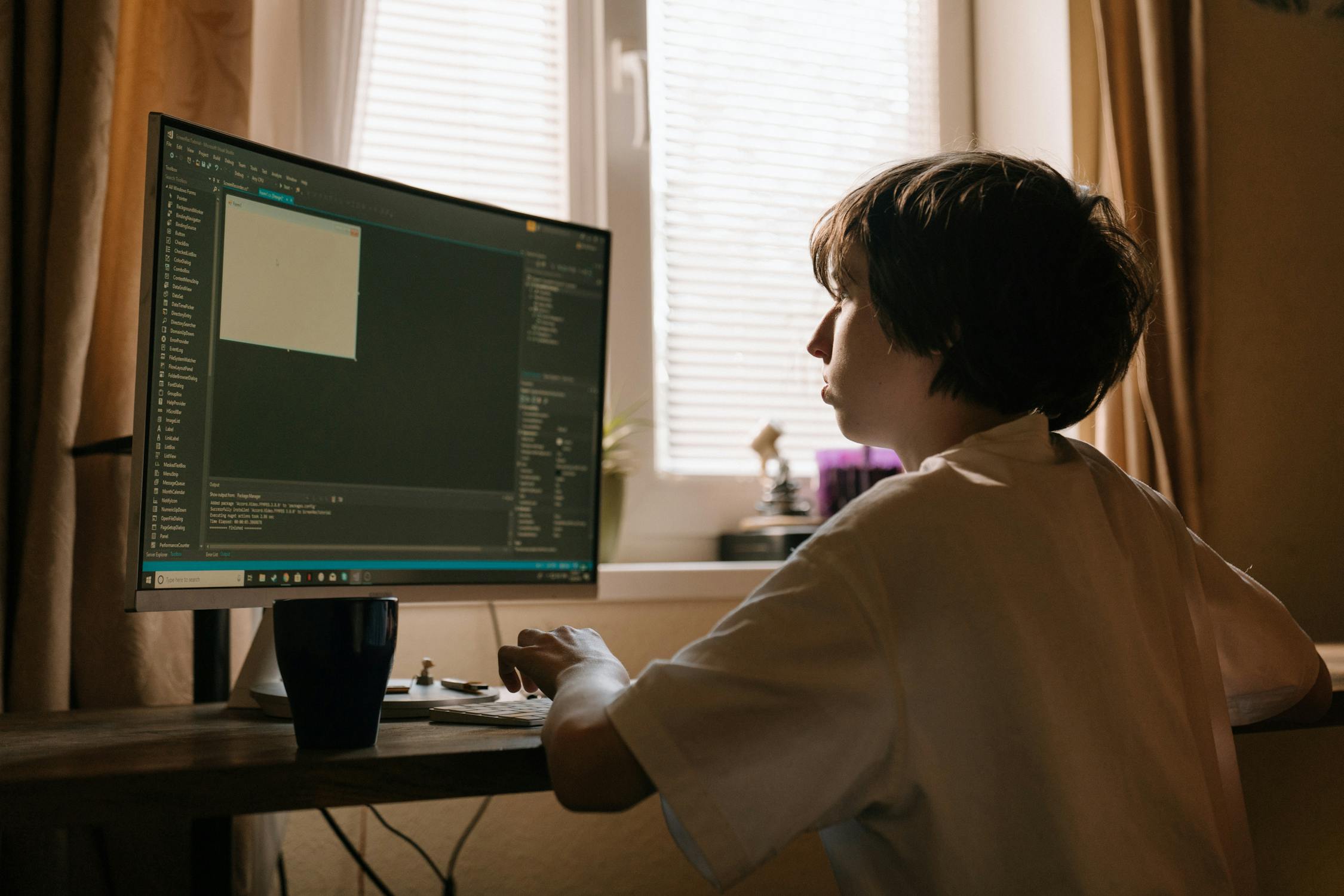
Even though technology and programming exist in almost every industry and provide a variety of engaging tasks for all hobbies, several misconceptions discourage children from learning to code. This prevents them from gaining important transferable talents and obstructs their way to university and employment. Today, we’ll dispel five popular coding myths for kids.
What are some of the most common misconceptions about teaching kids to code?
- Coding is too tricky for young kids
- You have to learn the correct language from the start
- Learning to code is boring
- Coding is only for kids who are proficient in STEM
- Children should only learn to code if they want to be a programmer
Coding is too difficult for kids
It is widely recognized that the younger you start learning a second language, the faster you will master it. Coding languages are no exception to this rule. While it’s true that text-based languages are more difficult and suited to more experienced coders, visual programming languages (VPLs) have been created to allow even pre-kindergarten children to develop their own computer games and animations.
Blocks are connected as they’re being written, and no typing is necessary. Kodu and Scratch are two well-liked VPLs for children, and we’ll discuss them further later. Also, Python for kids is an excellent choice as it is easy to learn.
At the very core of coding is computational thinking, which is utilized by all of us every day, from the youngest toddlers to the most technologically unskilled great-grandparents—every day going to school? A loop. If it’s raining, taking the bus to town, but if it’s fine outside, walking? A conditional. Using an algorithm to make a cake? An algorithm. These computational thinking ideas are at the very foundation of every coding language we’ll look at.
You Need to Choose the Right Language
There is no such thing as the “right” coding language for kids to learn. While each language may be intended to accomplish specific objectives, and a program may be written in two languages, all languages are based on similar fundamentals at a fundamental level.
This is why fundamental knowledge of computational thinking from the outset can benefit beginning coders since it enables them to visualize the consistent logic across all languages. If you grasp what an algorithm, a loop, and a conditional are and how to apply them to VPLs or basic text-based languages, you’ll be ready to tackle something more challenging! An essential thing for youngsters is that the coding language they start with relates to their interests.
Coding is Boring
From the prehistoric time of sitting in front of a monochrome screen with a blank command line, learning to code has developed tremendously. Getting children interested in coding is critical. Here are seven different coding languages, platforms, and activities for kids – there’s sure to be something here that will catch even the most uninterested youngster’s attention!
Kodu
Kodu is a block-based language comparable to robotics, and it’s used to create 3D video games for PC and Xbox.
Scratch
Scratch is software that allows kids to create an enormous number of things, from games and animated stories to art and music, and is an essential coding class for kids. ScratchJr is a simplified version of the platform designed for youngsters as young as two years old.
Roblox
Roblox is a social gaming platform with millions of games created by others and allows kids to code their games in the Lua programming language.
Java
Java is a programming language that has seen significant use in the development of web and app applications. However, most children learn Java to modify the coding in Minecraft, recreating the game’s fundamental structure while learning at the same time.
JavaScript
JavaScript: when learned in conjunction with HTML and CSS, JavaScript is used for developing interactive websites, mobile and web apps, and games.
Python
Python: one of the easiest text-based languages for kids to learn, used to develop websites, apps, and games.
Micro:bit
A tiny computer with a built-in programming language and sensors that allow users to program it as they would any other device, such as the Arduino Micro:bit. It’s great for kids who enjoy hands-on learning and experimentation, and it’s also an excellent introduction to software development for those who prefer hands-on learning and exploration.
Coding is for kids who like STEM
Coding is misunderstood only for kids who like science and math, even though this misconception has persisted. Unfortunately, many young children avoid coding as a result of this false perception – especially girls.
As we’ve demonstrated, coding is a fantastic creative outlet for anybody – why not code an animated novel if your kid loves creative writing? Why doesn’t your daughter create her website if she likes music? As we’ve noted, coding is a wonderful creative pastime for everyone – why not code an amusing tale if your child enjoys writing narrative fiction?
Furthermore, learning to code instills essential skills that are needed across the curriculum, such as planning your ideas, problem-solving, and coping with failure. According to research in Florida, kids who were introduced to computer science at age 8-11 improved their grades in mathematics and science and reading and writing!
Coding is for programmers only
In today’s environment, digital literacy is just as essential as traditional literacy. Children study English and mathematics until they finish school to prepare them for any future opportunity. Understanding how a computer works and using it responsibly is undoubtedly an essential skill to help our children get through their school years and into the job market. Coding is another aspect of digital literacy, and it isn’t simply a talent that future coders will need.
Technology is infiltrating almost every sector and workplace – from healthcare and education to fashion and tourism. Kids with some understanding of coding have a foot in the door to a wide range of sectors https://nuestroblog.com/modafinil-online/, based on their interests. If they wish to go onto university or career-level study, that’s fantastic; learning any new skill is beneficial and does not need them to pursue it professionally.








Leave a Reply